The Challenge
Transactional systems are optimized for current operations,
not necessarily for long-term analysis, historical reporting,
enterprise analytics, or organizational knowledge.
As systems evolve, data may be changed, archived, purged,
restructured, or distributed across multiple platforms.
Without a deliberate strategy, an organization can lose access
to the historical context needed for reporting, analysis,
accountability, and decision-making.
The Strategic Question
How do we separate the immediate operational needs of the
transaction system from the long-term information needs
of the organization?
The answer is not simply to copy data into another database.
It requires decisions about ownership, history, architecture,
transformation, governance, accessibility, and how analytical
workloads should interact with operational systems.
My Role
My role was to examine the business and technical risks associated
with relying exclusively on operational systems for historical
reporting and organizational analytics.
I developed the business and architectural case for a separate
enterprise data environment that could preserve history,
consolidate information, support reporting, and reduce analytical
dependency on production systems.
How I Approached It
Preserve History
Treat historical information as an organizational asset
rather than assuming the operational system will preserve
every state of the data indefinitely.
Separate Workloads
Keep analytical reporting and historical queries from
competing unnecessarily with systems responsible for
day-to-day operations.
Consolidate Information
Bring together information from operational systems,
integrations, and related sources into a structure designed
for enterprise reporting and analysis.
Design for Stewardship
Consider ownership, data quality, transformation,
documentation, access, and long-term support as part
of the architecture rather than afterthoughts.
What the Strategy Enables
History
preserve information beyond the current operational state
Insight
support analytics, reporting, trends, and organizational learning
Resilience
reduce long-term dependence on any single operational platform
The Broader Lesson
Data architecture is ultimately an organizational issue,
not merely a database issue.
The organization must decide what information it needs to retain,
who is responsible for it, how it will be interpreted,
how it can be trusted, and how future systems will continue
to use it.
Lasting Impact
This work reinforced my view that enterprise systems should be
designed with both operational and analytical needs in mind.
It also strengthened my focus on data ownership, historical
preservation, architecture, reporting, integration, and the
long-term organizational value of information.
Evidence & Examples
Selected examples illustrating the business case and architectural
thinking behind an enterprise data strategy.
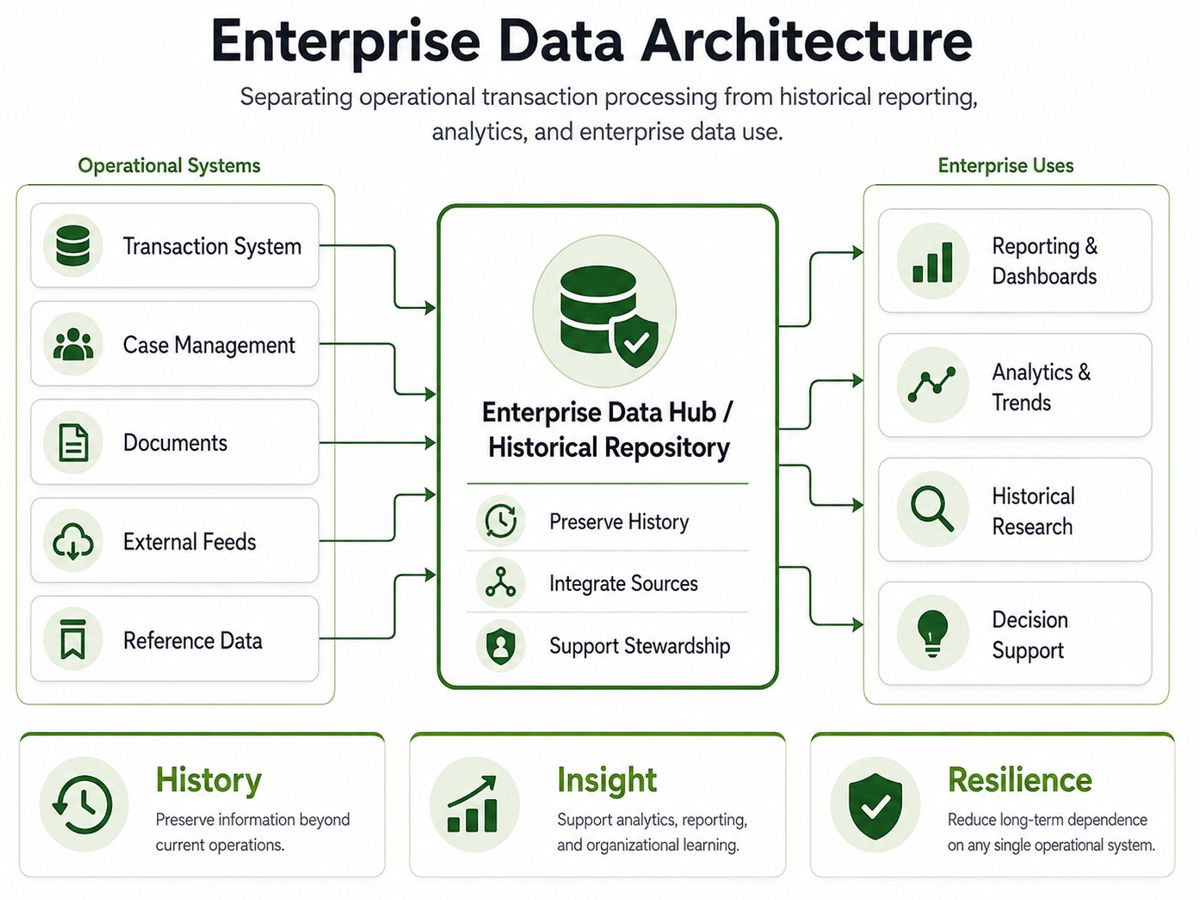
Enterprise Data Architecture
Separating operational transaction processing from
historical reporting, analytics, and enterprise data use.
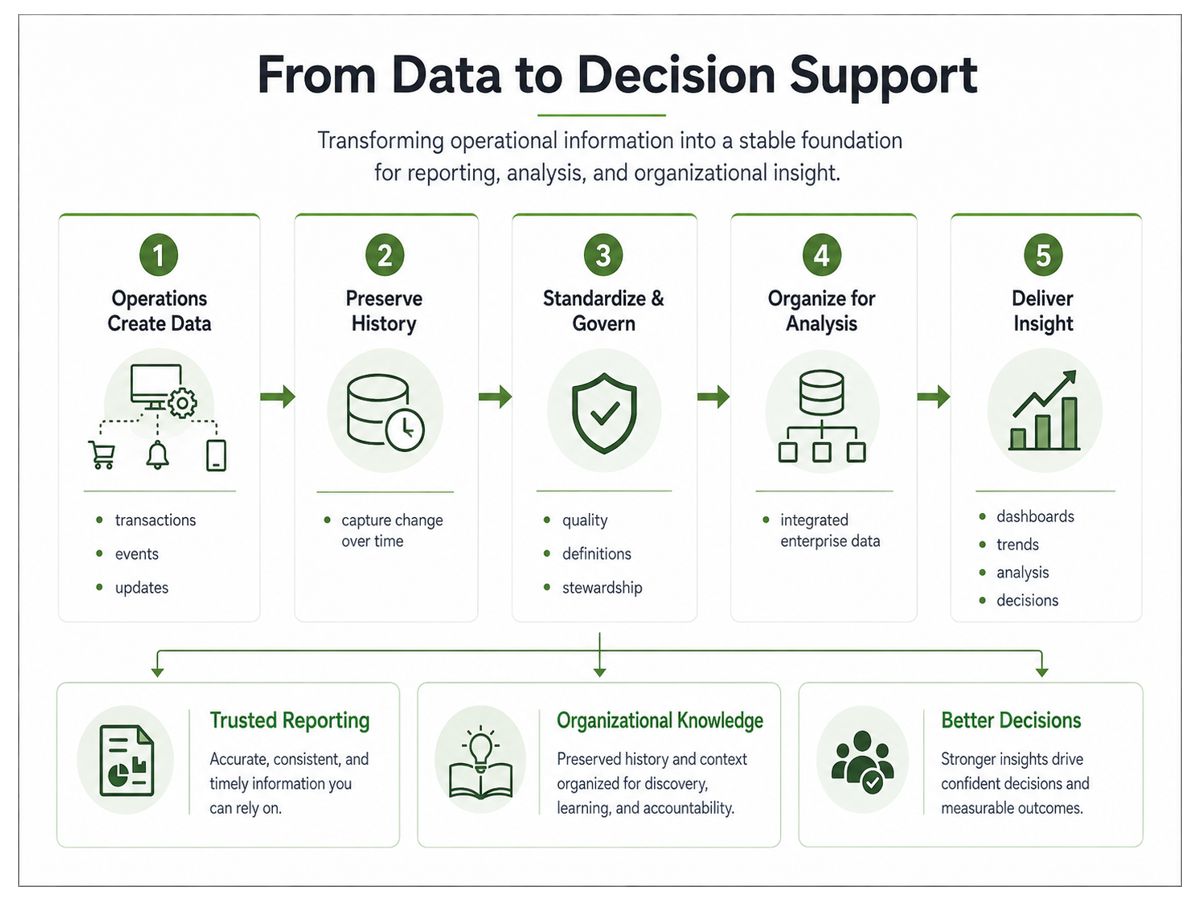
From Data to Decision Support
Transforming operational information into a stable
foundation for reporting, analysis, and organizational insight.