The Challenge
DAJD's jail-management environment relied on decades of accumulated
systems, processes, integrations, operational practices, and institutional
knowledge.
Replacing that environment required much more than implementing
new software. It required redesigning business processes,
coordinating across organizational boundaries, maintaining partner
integrations, supporting operational continuity, and helping a large
workforce move to a new way of working.
The Scale
300+
contributors across the broader project effort
1,100+
defined business and system requirements
17
partner agencies connected through real-time integrations
My Role
My contribution focused on the intersection of business process, data, integrations,
reporting, system behavior, and operational needs. I worked across technical and operational
teams to trace dependencies, translate requirements, identify downstream effects, and help
connect system changes to the business processes they supported.
I worked across technical and operational teams to help understand
how information moved through the environment, how business processes
depended on system behavior, and how changes in one area could affect
other teams, partners, and downstream systems.
How I Approached It
Understand the Business Process
Start with the operational need and understand how work
moves through the organization before focusing on the technology.
Trace the Data
Follow information across applications, databases,
integrations, reports, and external partners to understand
dependencies and downstream effects.
Connect the Stakeholders
Work across operational teams, technical staff, vendors,
and partner agencies to translate needs and resolve
cross-system issues.
Protect the Operation
Treat system changes as operational changes and consider
reliability, continuity, data quality, supportability,
and long-term ownership.
The Broader Lesson
Large enterprise systems are not simply technology projects.
They are organizational systems made up of people, process,
information, policy, infrastructure, vendors, and external partners.
The more interconnected the environment becomes, the more important
it is to understand those relationships as a whole rather than
treating each application or integration as an isolated component.
Lasting Impact
The JMS transformation reinforced the same systems-thinking approach
that had shaped my earlier quality-management and process work,
but at a much larger scale.
It also deepened my focus on enterprise integration, data ownership,
infrastructure risk, reporting, and the long-term support required
after a major implementation is complete.
Evidence & Examples
Selected examples illustrating the scale, complexity, and interconnected nature of the JMS transformation.
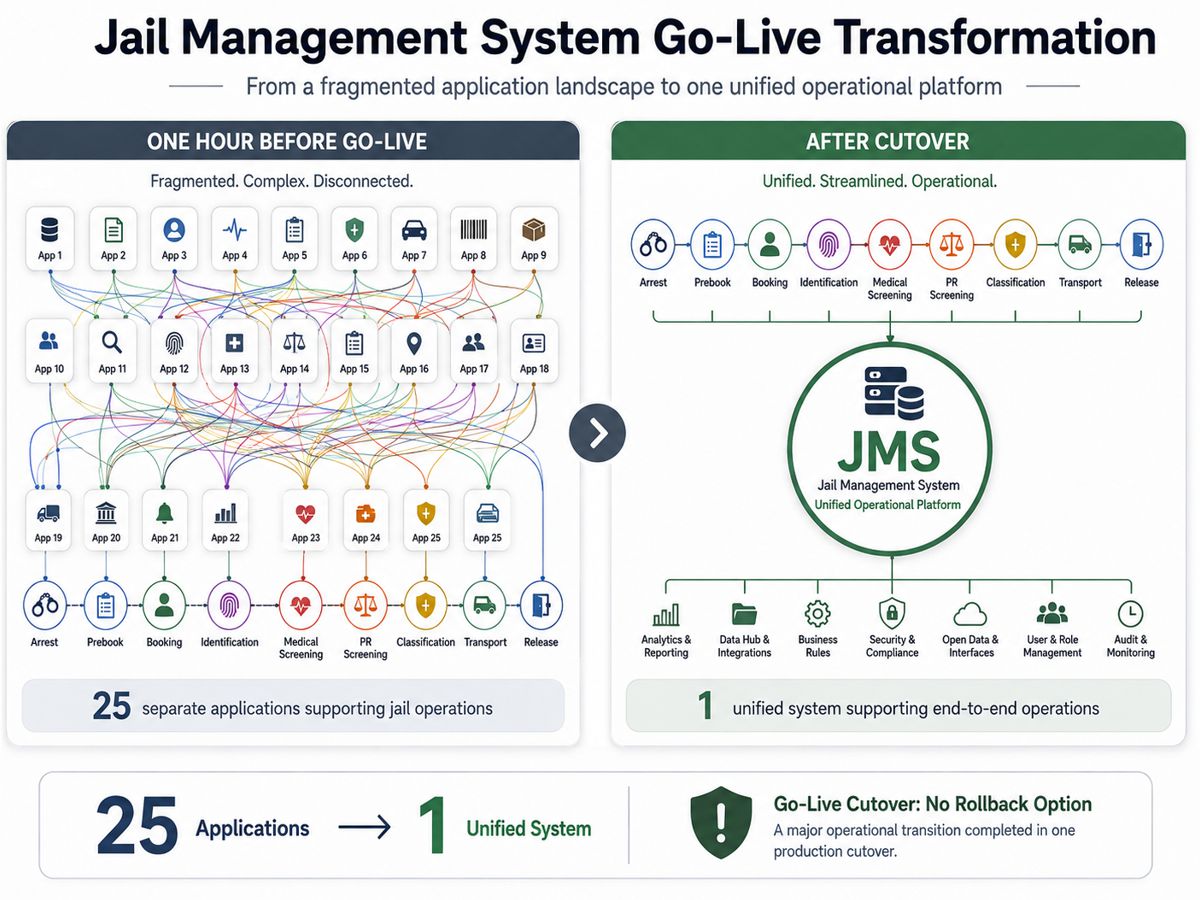
From Fragmented Systems to a Unified Platform
Immediately before go-live, DAJD relied on a complex
environment of legacy applications and interfaces.
JMS consolidated that environment into a single operational platform.
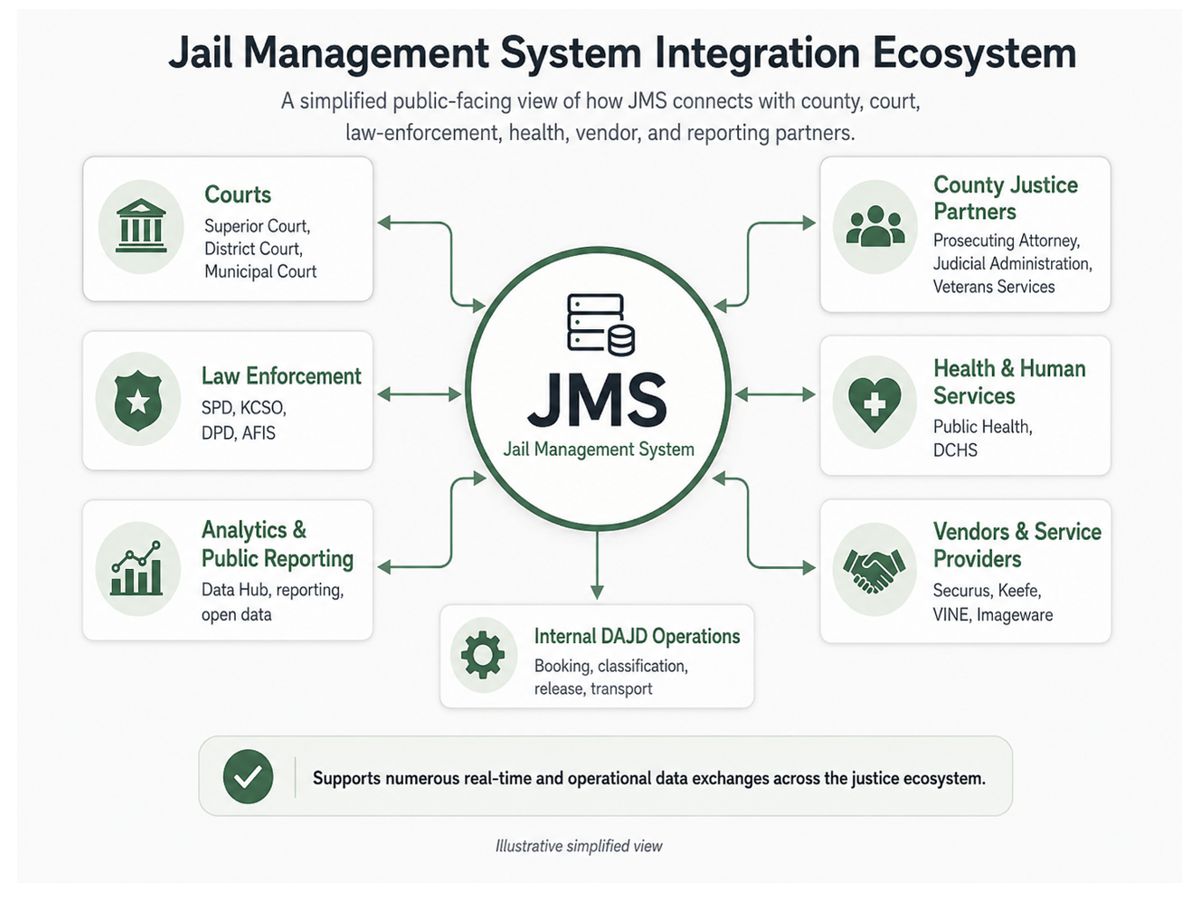
Integrated Operational Environment
JMS became part of a broader ecosystem of applications,
data flows, partner connections, reporting, and operational processes.