The Business Need
Finance staff relied on information distributed across pension
administration systems, accounting software, databases, files,
documents, and other operational sources.
The Finance Data System was designed to provide a central environment
where staff could manage routine work while independently accessing,
comparing, reporting, and auditing financial and member information.
What I Built
I developed FDS as a role-based ASP.NET application supporting both
operational workflow and direct access to enterprise information.
The application allowed Finance staff to manage projects, tasks,
documentation, notes, reporting, audits, and specialized financial
processes from one environment.
Rather than relying exclusively on the pension administration
applications for reporting, FDS connected directly to their underlying
Oracle data as well as financial information maintained in Microsoft
Dynamics SL. This allowed Finance to independently compare information
between systems and identify discrepancies.
Key Capabilities
Workflow & Task Management
Manage departmental processes, projects, assignments,
individual tasks, team tasks, documentation, and notes.
Financial Reporting
Produce payroll, budget, exception, audit, and financial
reports without requiring staff to work directly within
the source transaction systems.
Independent Audit & Reconciliation
Compare pension-system financial activity with data
transferred into Microsoft Dynamics SL to support
independent reconciliation and audit.
Enterprise Information Access
Search current and historical member information,
transmittals, lookup data, benefit-plan information,
employer information, and other operational records.
Data & Integration
SQL Server served as the application's primary data repository,
with substantial business logic implemented through T-SQL stored
procedures and functions.
FDS also integrated information from multiple enterprise sources,
including Oracle databases supporting the pension administration
systems, Microsoft Dynamics SL, SharePoint, flat files, Microsoft
Access, Microsoft Excel, and MySQL.
Pension Administration Systems
Oracle
→
Finance Data System
ASP.NET / SQL Server
↔
Financial System
Dynamics SL
Technology
ASP.NET
VB.NET
SQL Server
T-SQL
Telerik UI
AJAX
jQuery
XML
PowerShell
Oracle
Dynamics SL
SharePoint
Selected Screens
Examples of the operational, reporting, and financial functions
provided through the Finance Data System.
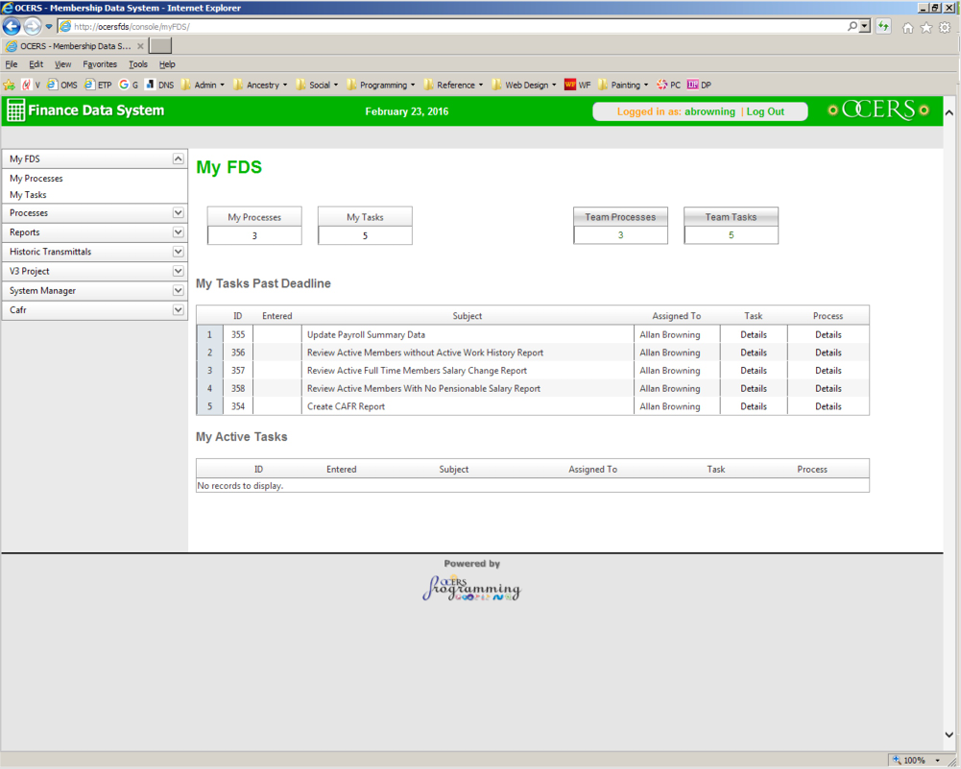
My FDS Dashboard
Personalized access to active tasks, overdue work,
team assignments, processes, reports, and other
departmental functions.
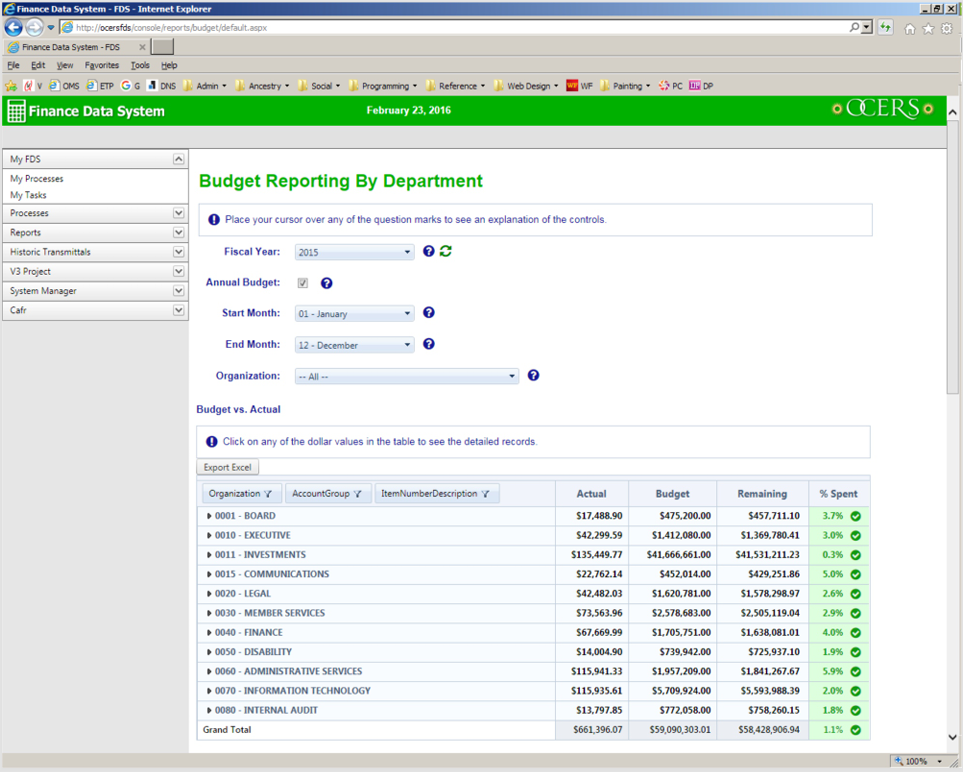
Budget Reporting
Department-level budget-versus-actual reporting with
drill-down access to detailed financial transactions
and export capabilities.
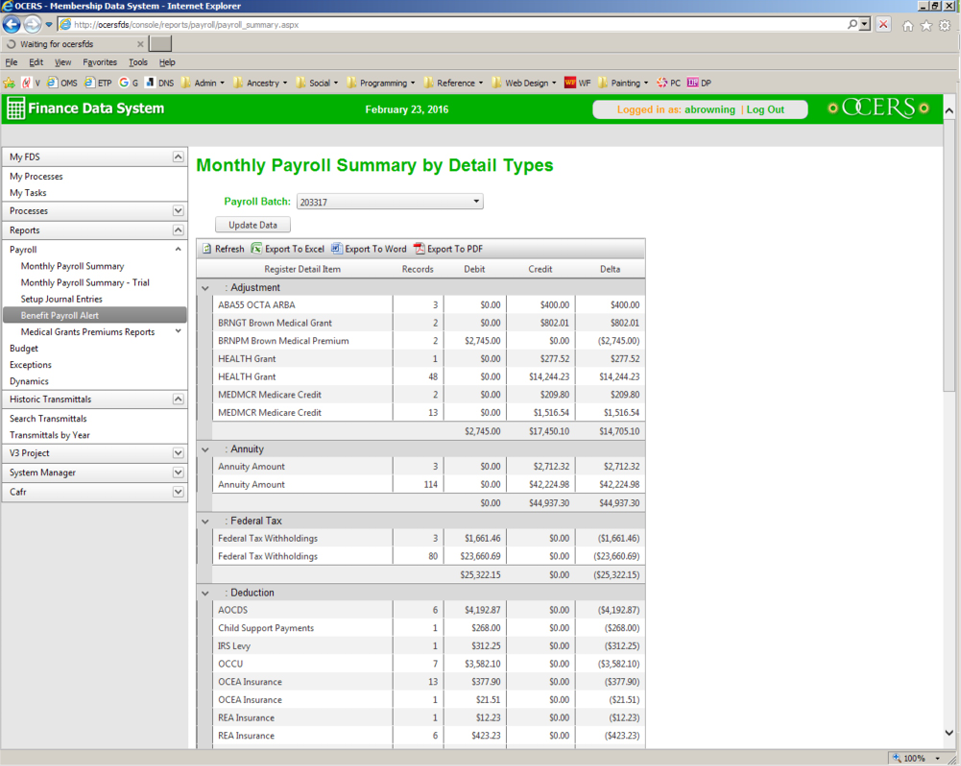
Payroll Analysis
Detailed payroll summaries grouped by adjustment,
annuity, tax, deduction, and other transaction types,
with reporting and export functionality.
Broader Value
Separating Information Needs From the Transaction System
One of the most important aspects of FDS was that Finance did not
have to depend entirely on operational applications to understand
its own information.
By connecting directly to source data and bringing information
together in a purpose-built environment, the department gained
greater independence for reporting, reconciliation, auditing,
analysis, and day-to-day management.