The Business Need
District information was distributed across many independent systems,
including student information, personnel, inventory, network services,
directories, help desk systems, databases, files, and other operational
platforms.
Staff often needed information from several of those environments,
but each system had its own interface, access model, and reporting
capabilities.
MIS was designed to provide a single point of access to reportable
information without becoming another transaction system.
What I Built
I developed MIS as a role-based ASP.NET application that aggregated
data from Oracle, MySQL, SQL Server, flat files, Active Directory,
and other district systems.
The application was intentionally read-oriented. Other than values
used to query reports, MIS did not update the source systems.
Its purpose was to make information easier to find, compare,
understand, and use without duplicating the operational functions
of the systems that created it.
Key Capabilities
Student & Teacher Information
Provide consolidated access to student, teacher, enrollment,
attendance, discipline, portalaccount, and related information
derived from the district's student information systems.
Personnel Information
Search employees by site, status, benefit eligibility,
account creation, and other personnel attributes from
multiple district information sources.
Technology & Asset Management
Provide reporting across inventory, projects, tasks,
help desk requests, technology assets, and supporting
infrastructure information.
Cross-System Reporting
Identify relationships and exceptions between systems,
including student accounts, directory services, staffing,
portal access, and operational records.
Data & Integration
SQL Server served as the primary MIS repository, with substantial
reporting and business logic implemented through T-SQL stored
procedures and functions.
MIS also integrated information from Oracle, MySQL, Active Directory,
Exchange Server, SharePoint, flat files, Microsoft Access,
Microsoft Excel, Microsoft System Center, and Cisco Unified
Communications Manager data.
Operational Systems
Student · HR · Inventory · IT
→
Management Information System
ASP.NET / SQL Server
→
Reporting & Decision Support
Role-Based Access
Core Reporting Modules
Aeries SideKick
Teacher and student lookup, account synchronization,
portal accounts, attendance, discipline, enrollment,
and cross-system exception reporting.
Inventory Management
Asset reporting by site, manufacturer, purchase order,
and related inventory attributes.
Information Technology Central
Reporting across master projects, projects, tasks,
and help desk requests.
Personnel Data System
Employee lookup, site-based reporting, account status,
benefit eligibility, and recent employee activity.
Substitute Calendar System
Reporting for approved, pending, and denied substitute
requests.
Other MIS Reporting
Additional district reporting tools and cross-system
information services could be incorporated under the same
role-based framework.
Technology
ASP.NET
VB.NET
SQL Server
T-SQL
Telerik UI
AJAX
jQuery
XML
PowerShell
Oracle
MySQL
Active Directory
Exchange
SharePoint
System Center
Selected Screens
Examples of the enterprise reporting and cross-system information
provided through MIS.
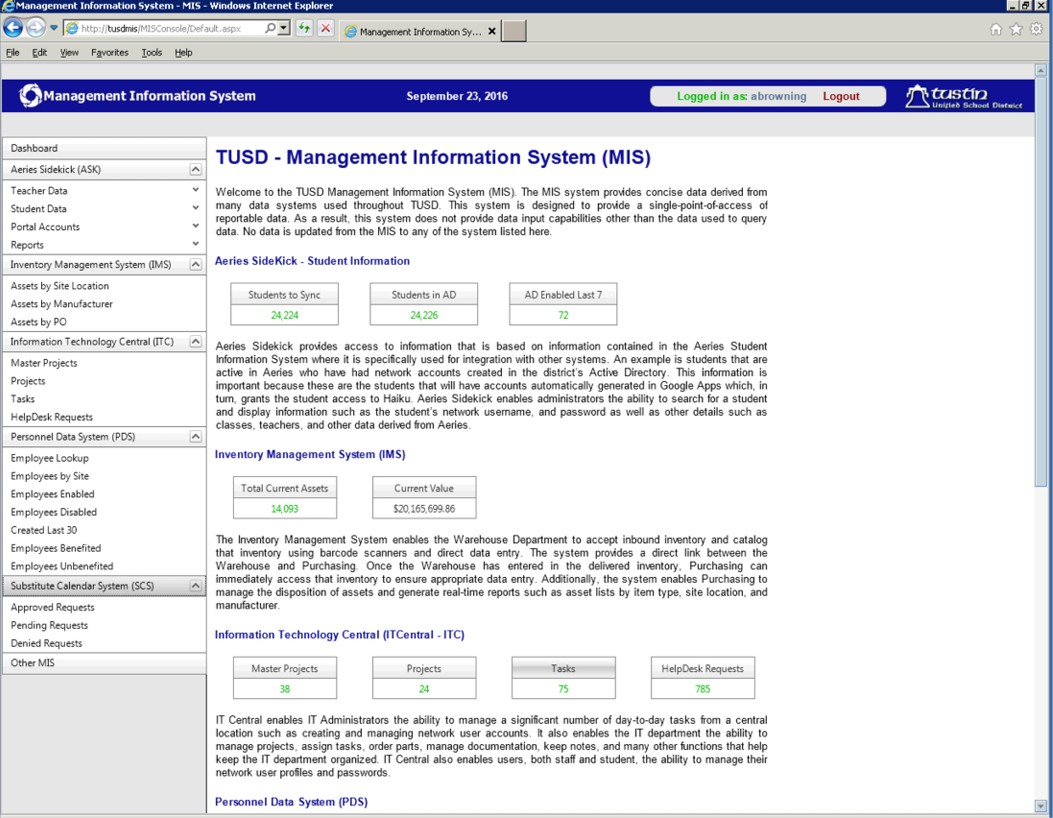
Enterprise Dashboard
A single entry point into student information, inventory,
IT operations, personnel data, substitute requests,
and other district reporting modules.
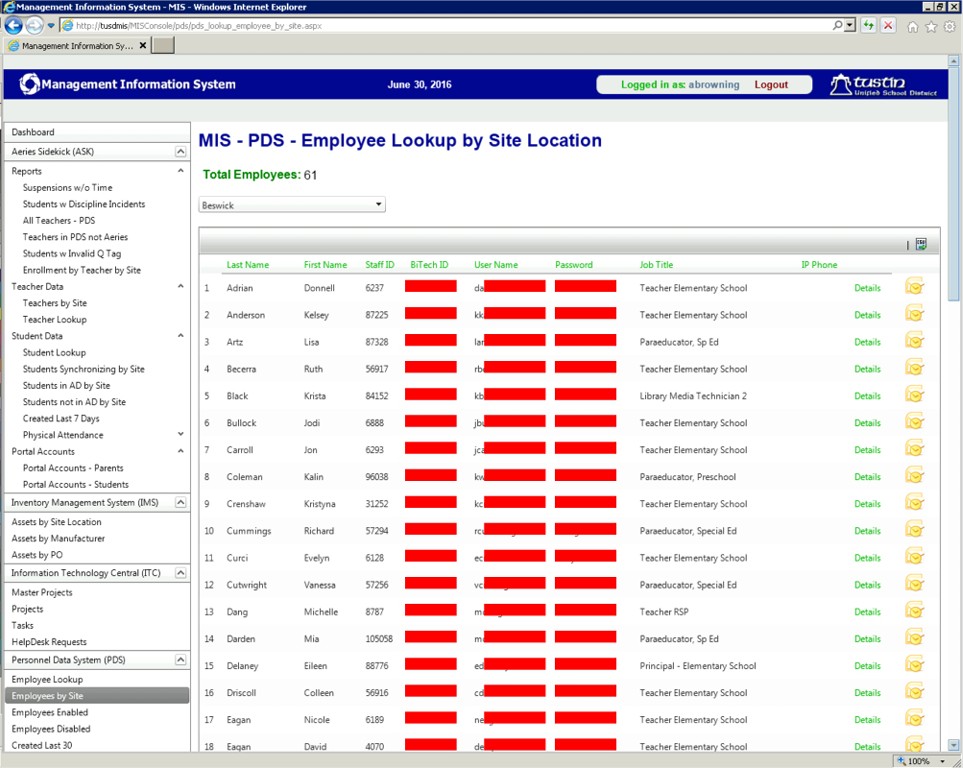
Employee Lookup
Site-based personnel lookup combining employee,
directory, account, job, and communication information
from multiple district sources.
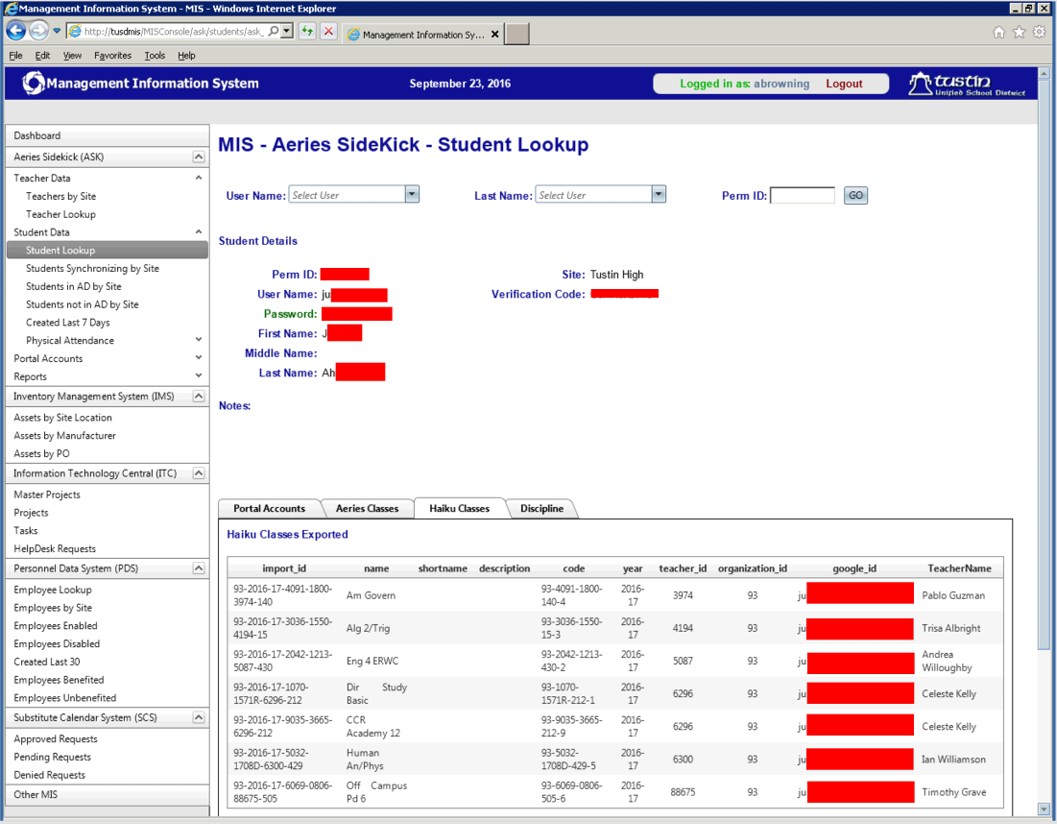
Aeries SideKick
Consolidated student information showing identity,
account information, classes, portal information,
discipline, and data derived from multiple connected systems.
Broader Value
One View Across Many Systems
The value of MIS was not creating another place to maintain data.
It was giving users a way to see information that already existed
across many systems as one organizational resource.
By separating information access from the applications that created
the data, MIS reduced the need for users to understand every source
system and made cross-system reporting and exception identification
significantly easier.